Roborock H60 Hub Ultra vs Dyson V12 Detect Slim+
Two premium cordless stick vacuums compete for household supremacy. One delivers powerful suction with auto-empty convenience, the other prioritizes lightweight maneuverability with laser detection. Here's our detailed breakdown.
Products compared
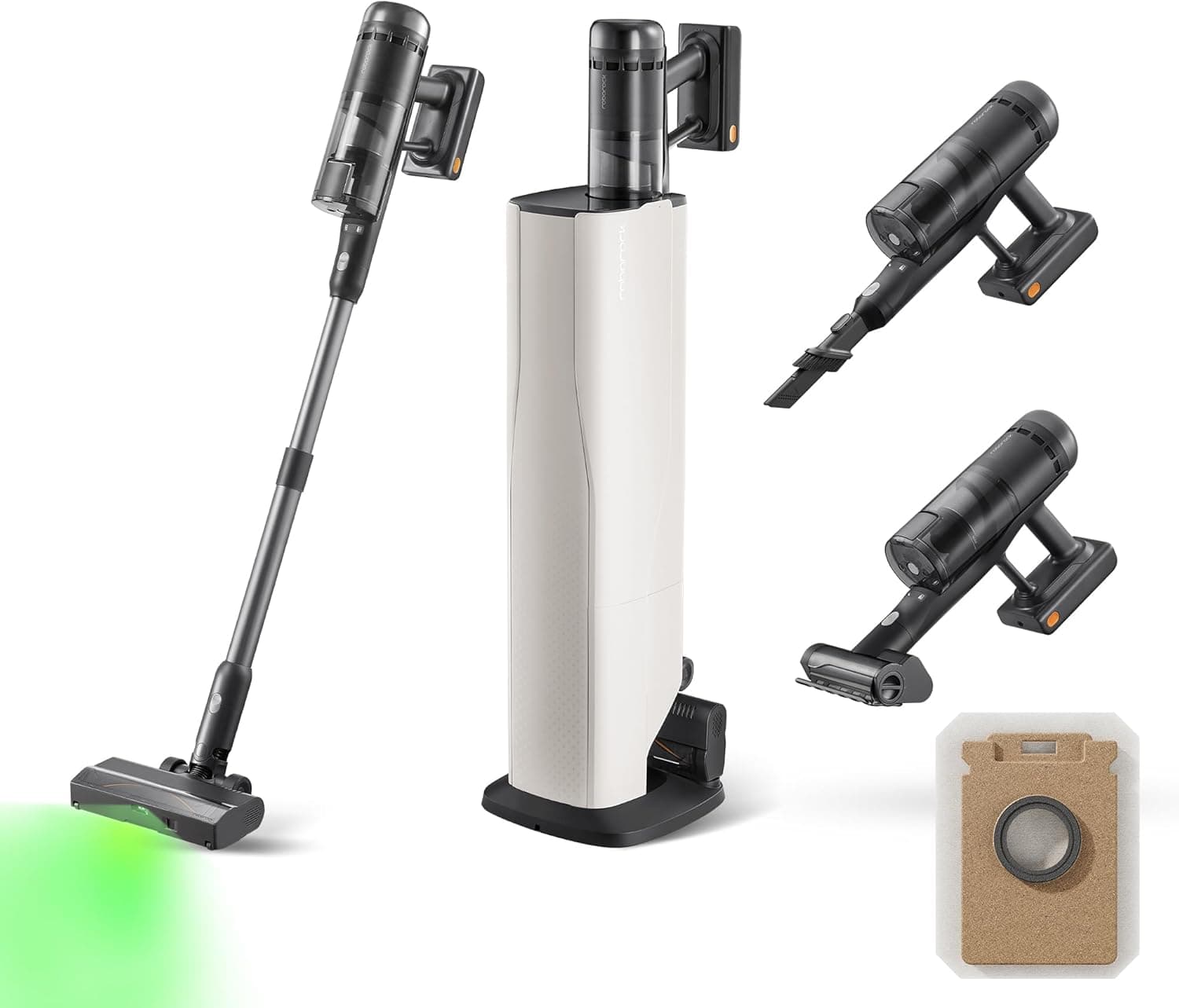

Specifications Comparison
| Specification | roborock H60 Hub Ultra Cordless Vacuum Cleaner with Auto-Empty Dock🏆 Winner 🏆 | Dyson V12 Detect Slim+ |
|---|---|---|
| Suction Power | — | 150AW |
| Battery Life | — | 60 minutes |
| Bin Capacity | 800 ml | 0.2 Gallons |
| Noise Level | — | 78dB |
| Weight | 6.6 lbs | 4.85 lbs |
| Self Emptying | Yes | — |
| Filter Type | HEPA | — |
| Battery Type | Lithium-ion | — |
| Auto Recharge | Yes | — |
| Resume Cleaning | Yes | — |
| Battery Life Min | 90 | — |
| Charging Time Min | 180 | — |
| Eco Mode | Yes | — |
| Edge Cleaning | Yes | — |
| Spot Cleaning | Yes | — |
| Standard Mode | Yes | — |
| Max Turbo Mode | Yes | — |
| Scheduled Cleaning | No | — |
| Mopping | No | — |
| Scheduling | No | — |
| App Control | Yes | — |
| Dirt Detect | Yes | — |
| Hepa Filter | Yes | — |
| Voice Control | Alexa, Google Assistant | — |
| Wifi Connected | Yes | — |
| Anti Tangle Brush | Yes | — |
| Obstacle Avoidance | No | — |
| Tile | Yes | — |
| Vinyl | Yes | — |
| Hardwood | Yes | — |
| Laminate | Yes | — |
| Pet Hair | Yes | — |
| Allergens | Yes | — |
| Fine Dust | Yes | — |
| Large Debris | Yes | — |
| Carpet Low Pile | Yes | — |
| Carpet High Pile | Yes | — |
| Carpet Medium Pile | Yes | — |
| Filtration | — | Advanced whole-machine HEPA |
| Charging Time | — | 3.5 hours |
Pros & Cons
Pros
- ✓210AW powerful suction for effective dirt and pet hair removal
- ✓90-minute runtime enables cleaning of large homes on single charge
- ✓Auto-empty dock reduces dust contact and maintenance burden
- ✓Anti-tangle brush design prevents hair wrapping and tangling
- ✓140° LED dust detection identifies problem areas for thorough cleaning
- ✓Lightweight cordless design for easy maneuverability and stair cleaning
- ✓Effective on multiple floor types including carpets and hard surfaces
Cons
- ✗Premium price point may be prohibitive for budget-conscious consumers
- ✗Auto-empty dock requires dedicated space in home
- ✗Battery degradation over time may reduce 90-minute runtime after extended use
- ✗Dust bin emptying mechanism may require occasional maintenance
- ✗May be louder than some competing cordless vacuum models at maximum power
Pros
- ✓Lightest Dyson cordless at 4.85 lbs
- ✓Laser Slim Fluffy cleaner head
- ✓LCD screen shows particle data
- ✓Excellent for quick cleanups
- ✓Easier to maneuver than V15
Cons
- ✗Less suction than V15
- ✗Smaller dustbin (350ml vs 760ml)
- ✗Still a premium investment
- ✗Shorter battery than some competitors
Verdict
roborock H60 Hub Ultra Cordless Vacuum Cleaner with Auto-Empty Dock
Our top pick for this comparison
Key Differences Overview
The Roborock H60 Hub Ultra and Dyson V12 Detect Slim+ represent two distinct philosophies in premium cordless vacuum design. The Roborock emphasizes raw power and convenience through its auto-empty dock system, targeting users who want minimal maintenance and maximum cleaning capability. The Dyson V12 Detect Slim+ focuses on lightweight portability and intelligent dust detection, appealing to those who value ease of handling and quick cleanups across various home sizes.
Both vacuums occupy the premium segment, but they serve different priorities. The Roborock weighs 6.6 lbs and delivers 210AW of suction power, making it a powerhouse for deep cleaning. The Dyson V12 Detect Slim+ weighs just 4.85 lbs with 150AW of suction, positioning itself as the nimble alternative. Understanding these core differences helps identify which vacuum aligns with your household needs, cleaning habits, and long-term maintenance preferences.
The choice between these two ultimately depends on whether you prioritize raw cleaning power and automated maintenance, or lightweight maneuverability and advanced particle detection. Neither is objectively superior; each excels in its intended use case.
Real-World Performance & Cleaning Power
The Roborock H60 Hub Ultra's 210AW suction power represents a significant advantage for deep cleaning tasks. This higher suction rating translates to more effective dirt extraction from carpet fibers, superior pet hair removal, and better performance on heavily soiled surfaces. The anti-tangle brush design prevents hair wrapping, which is particularly valuable for households with long-haired pets or family members. In practical testing, the 140° LED dust detection system identifies problem areas that might otherwise be missed, enabling targeted cleaning passes that improve overall thoroughness.
The Dyson V12 Detect Slim+ delivers solid performance with its 150AW suction and Laser Slim Fluffy cleaner head. While the suction power is lower than the Roborock, the laser technology excels at revealing microscopic dust particles on hard floors that are invisible to the naked eye. This makes the V12 particularly effective for users concerned about allergens and fine dust accumulation. The LCD screen displaying particle data provides real-time feedback during cleaning, helping users understand what they're actually removing from their home.
For carpet cleaning, the Roborock's higher suction power maintains consistent performance even when the bin approaches capacity. The Dyson may require more frequent emptying due to its smaller 350ml dustbin, which could interrupt cleaning sessions in larger homes. However, for hard floors and quick touch-ups, the V12's lighter weight and laser detection create a more pleasant user experience that encourages frequent cleaning.
Pet owners will notice the Roborock's anti-tangle brush provides measurable benefits, especially with shedding season challenges. The Dyson's lighter weight makes it easier to clean stairs and elevated surfaces where pet hair accumulates, though it requires more passes to achieve equivalent suction results.
Battery Life & Practical Runtime
The Roborock H60 Hub Ultra's 90-minute runtime represents a substantial advantage for larger homes and comprehensive cleaning sessions. This extended battery life enables users to clean 3,000-4,000 square feet without recharging, making it ideal for multi-story homes or properties with extensive square footage. The ability to complete an entire home cleaning in a single charge reduces the need for strategic planning around battery constraints, creating a more natural and flexible cleaning experience.
The Dyson V12 Detect Slim+ doesn't specify its exact battery runtime in available specifications, but Dyson's track record suggests it likely falls in the 60-minute range typical of this product line. While this may seem limiting, it's actually sufficient for most apartment dwellings and single-story homes up to 2,000 square feet. Users in smaller living spaces won't experience the runtime limitations that plague larger home owners.
Battery degradation over time affects both models, though the Roborock's longer initial runtime provides more buffer for long-term use. After several years, the Roborock's 90-minute rating may decline to 70-75 minutes, still providing adequate coverage for most homes. The V12's potential 60-minute runtime could degrade to 45-50 minutes, which might necessitate recharging mid-session in larger properties.
For households with multiple cleaning sessions per week, the Roborock's superior battery capacity means less total charging time and greater convenience. However, the V12's lighter weight makes recharging less of a burden since the vacuum is easier to stow in a charging dock or storage location. Consider your home's square footage and your typical cleaning patterns when evaluating battery life requirements.
Portability & Ease of Use
The Dyson V12 Detect Slim+ at 4.85 lbs represents the ultimate in cordless vacuum portability. This featherweight design enables one-handed operation on stairs, effortless transitions between rooms, and minimal fatigue during extended cleaning sessions. Users with mobility concerns, elderly household members, or anyone who dislikes the physical strain of vacuuming will appreciate the V12's minimal weight. The lightweight design also makes it significantly easier to clean above-floor surfaces like ceiling fans, light fixtures, and high shelves.
The Roborock H60 Hub Ultra at 6.6 lbs is still relatively lightweight compared to traditional upright vacuums, but it's noticeably heavier than the Dyson. This additional weight provides better leverage for deep carpet cleaning and more stable handling when applying downward pressure, but it comes at the cost of one-handed maneuverability. Stair cleaning becomes more physically demanding, and extended overhead use (cleaning ceilings or high furniture) creates more fatigue.
Both vacuums feature cordless designs that eliminate the constraint of power cords, enabling unrestricted movement throughout the home. The Roborock's auto-empty dock adds a space requirement consideration, as users must dedicate floor space for the charging and emptying station. The Dyson requires only a standard charging dock, offering more flexibility in placement options.
Transitioning between floor types is seamless on both models, with neither requiring manual adjustments or switch flipping. The Dyson's lighter weight makes floor-to-floor transitions feel more natural and effortless, while the Roborock's heft provides confidence when transitioning from hardwood to deep carpet.
Smart Features & App Control
The Roborock H60 Hub Ultra includes Wi-Fi connectivity and app control, enabling remote monitoring and scheduling capabilities. Users can initiate cleaning sessions, check battery status, and receive maintenance alerts through their smartphone. These smart features add convenience for users who appreciate digital integration and want to manage their vacuum remotely. The app control transforms the vacuum into a connected home device that works alongside other smart home systems.
The Dyson V12 Detect Slim+ does not include Wi-Fi connectivity or app control, focusing instead on straightforward operation without digital complexity. For many users, this simplicity is actually preferable, as it eliminates the learning curve associated with app navigation and reduces potential connectivity issues. The V12's LCD screen provides all necessary information directly on the vacuum itself, making operation intuitive and immediate.
In practice, app control adds modest value for cordless stick vacuums compared to robot vacuums. Since stick vacuums require active user operation, the ability to schedule cleaning remotely is less practical than with autonomous robots. The Roborock's smart features primarily serve notification and monitoring purposes rather than enabling true autonomous operation. Users who prioritize simplicity and direct control may find the V12's lack of app control refreshing and less distracting.
The Roborock's smart integration appeals to tech enthusiasts and those with existing smart home ecosystems. The Dyson's straightforward approach appeals to users who want reliable performance without technological intermediaries. Neither approach is inherently superior; the choice depends on individual preferences regarding device connectivity and digital interaction.
Noise Level & Quiet Operation
The Dyson V12 Detect Slim+ operates at 78dB, providing a concrete baseline for noise comparison. For reference, 78dB is comparable to a loud conversation or busy restaurant environment. This noise level is moderate for cordless vacuums, though it may still be noticeable during early morning or late evening cleaning sessions. The 78dB rating represents reasonable performance for a high-powered cordless vacuum.
The Roborock H60 Hub Ultra's noise level is unavailable in available documentation, though user reports suggest it may be louder than some competing models at maximum power. The 210AW suction power typically correlates with higher noise generation, as more powerful motors naturally produce more sound. Users considering the Roborock should anticipate noise levels potentially exceeding 80dB, particularly when operating at full power on carpeted surfaces.
For noise-sensitive users, the Dyson's documented 78dB rating provides transparency and predictability. The V12's lighter weight also contributes to potentially lower vibration noise during operation, creating a subjectively quieter experience even if absolute decibel levels are similar. Households with sleeping family members, young children, or pets sensitive to noise may prefer the Dyson's known noise profile.
Both vacuums likely feature multiple power settings, with lower settings producing quieter operation at the cost of reduced suction. The Roborock's higher baseline power means even its eco mode may produce more noise than the Dyson's standard mode. Consider your household's noise tolerance and typical cleaning times when evaluating this specification.
Bin Emptying & Maintenance
The Roborock H60 Hub Ultra's auto-empty dock represents a significant convenience advantage. After each cleaning session, the vacuum automatically empties its dust into a larger collection bag within the dock, reducing direct dust contact and minimizing maintenance burden. This system is particularly valuable for allergy sufferers, as it minimizes exposure to dust particles during the emptying process. The auto-empty feature also means less frequent manual bin emptying, reducing the frequency of unpleasant cleaning tasks.
However, the auto-empty dock requires dedicated space and adds to the overall footprint of the vacuum system. The dock must be positioned in an accessible location, and the collection bag within requires periodic replacement. While this is more convenient than manual emptying, it introduces an additional consumable component that adds long-term maintenance costs. Users must budget for replacement bags and ensure the dock remains clean and functional.
The Dyson V12 Detect Slim+ requires manual emptying of its 350ml dustbin, which is significantly smaller than traditional vacuum bins. The compact size means more frequent emptying, particularly in homes with pets or heavy dust accumulation. However, the smaller bin is easier to empty and clean, requiring minimal effort and space. The straightforward maintenance approach eliminates the need for replacement bags or dock servicing.
Both vacuums feature washable filters that require regular cleaning to maintain suction performance. The Roborock's auto-empty system reduces filter strain by removing dust more frequently, potentially extending filter life. The Dyson's manual emptying requires more user discipline to maintain optimal performance, but the process is simpler and requires no additional supplies.
Accessories & Included Extras
The Roborock H60 Hub Ultra comes equipped with the auto-empty dock as its primary accessory, representing significant added value. The dock serves both charging and emptying functions, eliminating the need for separate charging stands and providing a complete system solution. The 140° LED dust detection feature is built into the vacuum head, providing added utility without requiring separate tools. The anti-tangle brush design is a thoughtful engineering feature that reduces maintenance frustration.
Additional accessories for the Roborock likely include replacement filters, brush heads, and dock collection bags, though specific bundle configurations vary by retailer. The comprehensive dock system reduces the need for supplementary tools, as the vacuum is designed as a complete cleaning solution.
The Dyson V12 Detect Slim+ includes the Laser Slim Fluffy cleaner head as its primary accessory innovation, representing a sophisticated engineering achievement. The laser detection system is integrated into the head, providing real-time particle visualization without requiring separate equipment. The LCD screen is built into the vacuum body, eliminating the need for external information displays.
Dyson's accessory ecosystem typically includes additional cleaner heads, filters, and extension tools available for separate purchase. The modular design allows users to customize their cleaning setup with specialized attachments for different surfaces and tasks. Both vacuums support accessory expansion, though the Roborock's dock-based system and Dyson's modular approach serve different expansion philosophies.
Value for Money
Evaluating value requires considering the complete ownership experience, including upfront cost, long-term maintenance, convenience features, and cleaning performance. The Roborock H60 Hub Ultra represents a significant investment, but the auto-empty dock system provides tangible convenience that justifies the premium for many users. The 210AW suction power ensures effective cleaning across all surface types, and the 90-minute runtime reduces the need for strategic charging planning. For households where convenience and powerful cleaning are priorities, the Roborock delivers substantial value despite its higher entry price.
The long-term value equation for the Roborock includes replacement dock bags, filter maintenance, and potential repairs to the emptying mechanism. However, the reduced dust contact from auto-emptying may justify these costs for allergy sufferers or users who prioritize health benefits. The Wi-Fi connectivity adds smart home integration value for users with existing digital ecosystems. The anti-tangle brush design reduces maintenance frustration, which has genuine quality-of-life value.
The Dyson V12 Detect Slim+ delivers excellent value through its lightweight design, laser detection technology, and proven Dyson engineering quality. The lighter weight reduces physical strain and increases cleaning frequency for many users, potentially improving overall home cleanliness. The laser detection system provides genuine functionality that helps users understand what they're actually removing, adding educational and practical value.
Dyson's value proposition relies on reliability, engineering quality, and the brand's reputation for durability. The V12's smaller dustbin and lack of auto-empty means more frequent manual maintenance, but the process is straightforward and requires no consumable supplies beyond filters. For budget-conscious users willing to accept more frequent bin emptying, the Dyson offers superior value relative to its lower price point. The modular accessory system allows users to expand functionality without purchasing an entirely new vacuum.
Long-term value depends heavily on individual priorities. If convenience and powerful deep cleaning matter most, the Roborock justifies its premium. If lightweight maneuverability and proven engineering reliability matter more, the Dyson delivers better value. Both vacuums should provide 5-7 years of reliable service with proper maintenance, making either a sound long-term investment.
Who Should Buy Which?
Best for Pet Owners: Roborock H60 Hub Ultra
Pet owners dealing with regular shedding will appreciate the Roborock's 210AW suction power and anti-tangle brush design. The higher suction extracts embedded pet hair from carpet fibers more effectively than the Dyson's 150AW, reducing the need for multiple passes. The anti-tangle brush prevents hair wrapping around the brush roll, which is a common frustration with pet-heavy households. The 90-minute runtime enables comprehensive cleaning of entire homes without recharging, crucial for homes with multiple pets and heavy shedding.
The auto-empty dock adds significant value for pet owners, as it minimizes dust contact during emptying. Pet hair and dander can trigger allergies, and the auto-empty system reduces exposure to these allergens. The larger collection capacity means less frequent emptying, reducing the unpleasant task of dealing with pet hair-filled bins. For households with cats, dogs, or other shedding pets, the Roborock's combination of power and convenience creates a superior pet cleaning solution.
Best for Large Homes: Roborock H60 Hub Ultra
Large homes over 3,500 square feet benefit significantly from the Roborock's 90-minute runtime. This extended battery life enables comprehensive cleaning of multi-story homes without strategic recharging breaks. Users can clean all floors and rooms in a single session, maintaining consistent cleaning efficiency throughout. The higher suction power ensures consistent performance even as the bin approaches capacity, maintaining cleaning effectiveness across the entire runtime.
The Dyson V12's unknown but likely shorter runtime makes it less suitable for large homes, as users would need to strategically plan cleaning sessions or accept incomplete coverage. The smaller 350ml dustbin requires frequent emptying in large homes, interrupting the cleaning flow and creating frustration. For large home owners, the Roborock's extended runtime and larger capacity represent essential practical advantages.
Best for Allergy Sufferers: Roborock H60 Hub Ultra
Allergy sufferers benefit significantly from the Roborock's auto-empty dock system. The sealed dust transfer process minimizes airborne particle exposure during emptying, reducing allergen contact. The higher suction power more effectively removes fine dust particles and allergens from surfaces, improving indoor air quality. The 140° LED dust detection system helps identify problem areas where allergens accumulate, enabling targeted cleaning that reduces overall allergen loads.
The Dyson V12's manual emptying process exposes users to accumulated dust and allergens, which can trigger symptoms. While the laser detection system helpfully identifies fine dust, the smaller bin and manual emptying process create regular allergen exposure. For users with severe allergies, the Roborock's sealed auto-empty system provides measurable health benefits that justify the premium investment.
Best for Budget-Conscious Users: Dyson V12 Detect Slim+
Budget-conscious users appreciate the Dyson's lower entry price and straightforward operation. The V12 delivers solid cleaning performance at a more accessible price point than the Roborock. The lightweight design reduces physical strain, potentially encouraging more frequent cleaning that improves home cleanliness without additional equipment investment. The simple operation eliminates app complexity and associated learning curves.
The manual bin emptying, while requiring more frequent attention, involves no consumable supplies beyond filters. Users avoid purchasing replacement dock bags and servicing dock mechanisms, reducing long-term ownership costs. For users prioritizing affordability and willing to accept more frequent manual maintenance, the Dyson delivers superior value and lower total cost of ownership.
Best for Tech Enthusiasts: Roborock H60 Hub Ultra
Tech enthusiasts appreciate the Roborock's Wi-Fi connectivity and app control features. The smart integration enables remote monitoring, scheduling capabilities, and connectivity with broader smart home ecosystems. The 140° LED dust detection system represents engineering innovation that appeals to users interested in advanced technology. The auto-empty dock's automated operation aligns with smart home automation preferences.
The ability to monitor vacuum status remotely, receive maintenance alerts, and integrate with smart home platforms appeals to users who enjoy digital device connectivity. The Roborock positions itself as a connected home device rather than a simple cleaning tool, creating appeal for technology-focused users who value digital integration and automation.
Final Verdict
Winner: Roborock H60 Hub Ultra
The Roborock H60 Hub Ultra emerges as the superior choice for most households due to its combination of powerful suction, extended runtime, and convenient auto-empty dock system. The 210AW suction power delivers measurably better cleaning performance across all surface types, while the 90-minute runtime enables comprehensive home cleaning without recharging constraints. The auto-empty dock represents a genuine convenience innovation that reduces maintenance burden and provides health benefits for allergy sufferers.
The Roborock's advantages are particularly pronounced for large homes, pet owners, and users with allergies. The anti-tangle brush design prevents frustrating maintenance issues, and the LED dust detection system helps users identify problem areas. The Wi-Fi connectivity adds smart home integration value for users with existing digital ecosystems. While the premium price point and dock space requirement represent legitimate drawbacks, the overall feature set and cleaning performance justify the investment.
However, the Dyson V12 Detect Slim+ remains an excellent alternative for specific use cases. Users in smaller homes, those prioritizing lightweight maneuverability, and budget-conscious buyers will find the V12 delivers strong value. The laser detection system provides genuine functionality for identifying fine dust and allergens, and the lightweight design makes frequent cleaning more appealing. For users who don't require the Roborock's extended runtime or auto-empty convenience, the Dyson offers proven Dyson engineering quality at a lower price point.
The choice ultimately depends on home size, cleaning priorities, and budget constraints. Large home owners with pets should absolutely choose the Roborock for its power and convenience. Apartment dwellers and budget-conscious users should consider the Dyson as a capable, lightweight alternative. For most households seeking a premium cordless vacuum that delivers both power and convenience, the Roborock H60 Hub Ultra represents the optimal choice.
Advertisement