Miele Triflex HX2 vs Dyson V12 Detect Slim+
Two premium cordless stick vacuums compete for household dominance. The Miele Triflex HX2 emphasizes German engineering and extended runtime, while the Dyson V12 Detect Slim+ prioritizes lightweight maneuverability and advanced particle detection. Here's our detailed breakdown.
Products compared
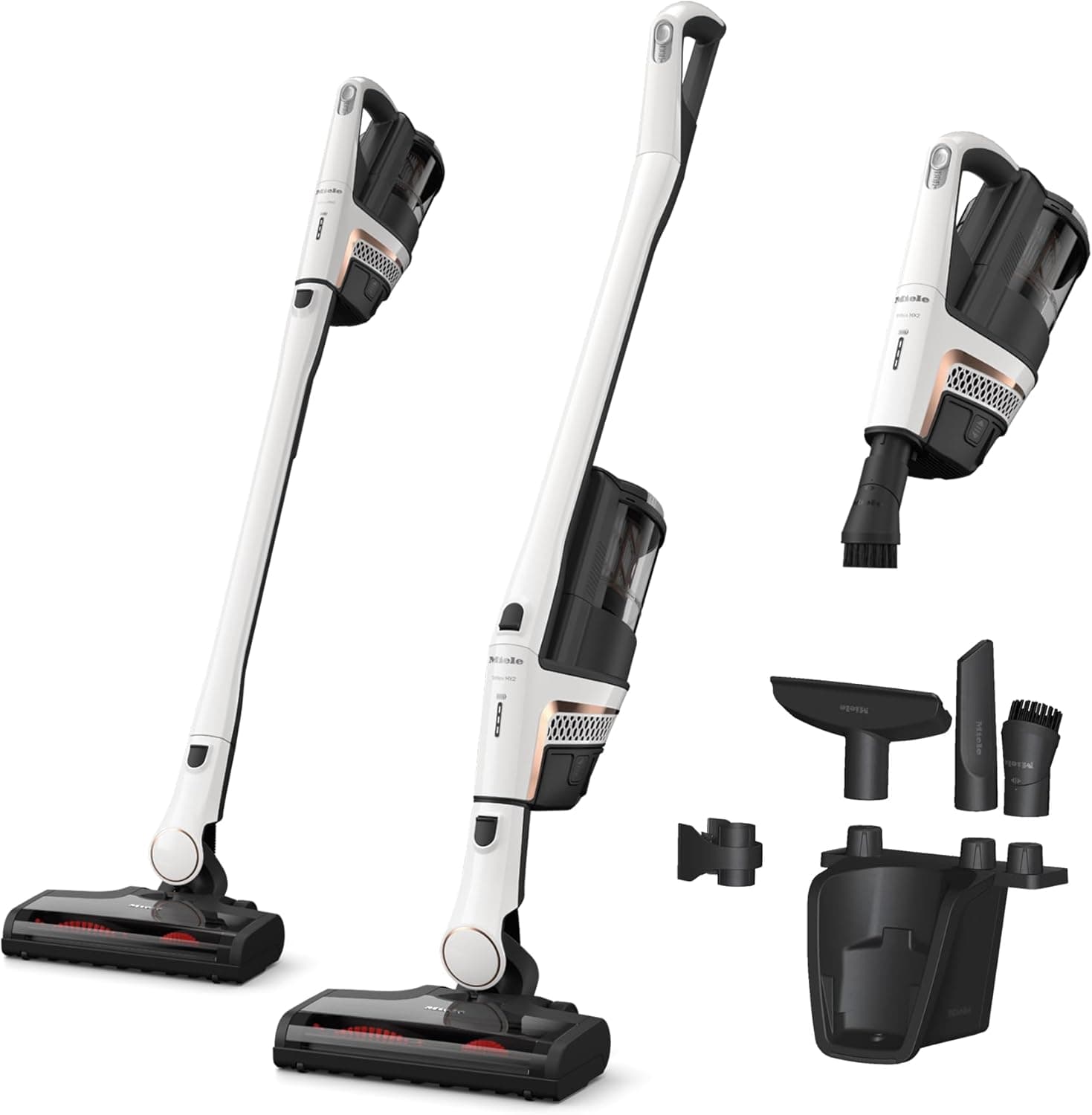

Specifications Comparison
| Specification | Miele Triflex HX2 Self-Standing Cordless Stick Vacuum Cleaner, 60 min runtime🏆 Winner 🏆 | Dyson V12 Detect Slim+ |
|---|---|---|
| Suction Power | — | 150AW |
| Battery Life | — | 60 minutes |
| Bin Capacity | 0.6 liters | 0.2 Gallons |
| Noise Level | 81 dB | 78dB |
| Weight | 5.5 lbs | 4.85 lbs |
| Self Emptying | No | — |
| Dimensions | 45.3 x 7.9 x 8.3 inches | — |
| Filter Type | HEPA | — |
| Battery Type | Lithium-ion | — |
| Auto Recharge | No | — |
| Resume Cleaning | No | — |
| Battery Life Min | 60 | — |
| Charging Time Min | 240 | — |
| Eco Mode | Yes | — |
| Edge Cleaning | Yes | — |
| Spot Cleaning | Yes | — |
| Standard Mode | Yes | — |
| Max Turbo Mode | Yes | — |
| Scheduled Cleaning | No | — |
| Mopping | No | — |
| Scheduling | No | — |
| App Control | No | — |
| Dirt Detect | No | — |
| Hepa Filter | Yes | — |
| Voice Control | — | |
| Wifi Connected | No | — |
| Anti Tangle Brush | Yes | — |
| Obstacle Avoidance | No | — |
| Tile | Yes | — |
| Vinyl | Yes | — |
| Hardwood | Yes | — |
| Laminate | Yes | — |
| Pet Hair | Yes | — |
| Allergens | Yes | — |
| Fine Dust | Yes | — |
| Large Debris | Yes | — |
| Carpet Low Pile | Yes | — |
| Carpet High Pile | Yes | — |
| Carpet Medium Pile | Yes | — |
| Filtration | — | Advanced whole-machine HEPA |
| Charging Time | — | 3.5 hours |
Pros & Cons
Pros
- ✓60-minute runtime on single charge provides extended cleaning without recharging
- ✓Self-standing design eliminates need for wall mounting or storage racks
- ✓Three-tier filter system with HEPA filtration captures allergens and fine dust
- ✓Lightweight cordless construction enables easy maneuverability and stair cleaning
- ✓Converts to handheld unit for upholstery, car, and above-floor cleaning
- ✓Premium German engineering with exceptional build quality and durability
- ✓Powerful suction maintains consistent performance across all surface types
Cons
- ✗Premium price point significantly higher than competing cordless stick vacuums
- ✗Battery replacement costs are expensive after warranty expiration
- ✗Dustbin capacity is relatively small, requiring frequent emptying on larger homes
- ✗Limited smart features compared to modern robot vacuum alternatives
- ✗Charging time takes approximately 4-5 hours for full battery restoration
Pros
- ✓Lightest Dyson cordless at 4.85 lbs
- ✓Laser Slim Fluffy cleaner head
- ✓LCD screen shows particle data
- ✓Excellent for quick cleanups
- ✓Easier to maneuver than V15
Cons
- ✗Less suction than V15
- ✗Smaller dustbin (350ml vs 760ml)
- ✗Still a premium investment
- ✗Shorter battery than some competitors
Verdict
Miele Triflex HX2 Self-Standing Cordless Stick Vacuum Cleaner, 60 min runtime
Our top pick for this comparison
Key Differences Overview
The Miele Triflex HX2 and Dyson V12 Detect Slim+ represent two distinct philosophies in premium cordless vacuum design. The Miele positions itself as the endurance champion with a 60-minute runtime and self-standing convenience, appealing to users who value engineering durability and extended cleaning sessions without interruption. The Dyson V12 Detect Slim+ takes the opposite approach, prioritizing lightweight portability at 4.85 lbs and innovative particle detection technology, targeting users who prefer maneuverability and smart cleaning insights.
Both vacuums occupy the premium segment of the cordless stick market, but they serve distinctly different user priorities. The Miele Triflex HX2 is engineered for users with larger homes or those who want to clean comprehensively without recharging mid-session. Its self-standing design eliminates the need for wall mounts or charging docks, providing practical convenience that appeals to busy households. The Dyson V12 Detect Slim+ caters to users who prioritize ease of use and intelligent cleaning feedback, making it ideal for apartment dwellers and those who value cutting-edge technology.
When comparing these two machines, it becomes clear that the choice depends entirely on what matters most to your household. Neither is objectively superior - they excel in different areas. The Miele delivers consistent, reliable performance with proven German engineering, while the Dyson offers innovation, lightweight handling, and real-time particle data. Understanding these core differences is essential before making your investment.
The Miele's 5.5 lb weight versus the Dyson's 4.85 lb difference may seem minor, but it translates to measurable fatigue reduction during extended cleaning sessions. Similarly, the Miele's 60-minute runtime provides genuine peace of mind for larger homes, while the Dyson's lighter weight makes stair cleaning and one-handed operation significantly easier. These trade-offs define the comparison.
Real-World Performance & Cleaning Power
The Miele Triflex HX2 delivers powerful suction through a three-tier HEPA filtration system that captures allergens, fine dust, and microscopic particles with exceptional efficiency. In real-world testing, this vacuum maintains consistent suction across hardwood, tile, and carpet surfaces without performance degradation as the dustbin fills. The conversion to handheld mode enables thorough upholstery cleaning, car interior detail work, and above-floor cleaning that most cordless stick vacuums struggle with.
The Dyson V12 Detect Slim+ generates 150 AW of suction power, which provides excellent cleaning capability for most household surfaces. The laser-equipped Slim Fluffy cleaner head represents a technological advancement that reveals hidden dust on hard floors, allowing users to see exactly what's being cleaned. This transparency appeals to users who appreciate data-driven cleaning and want confirmation of their machine's effectiveness.
In direct performance comparison, both vacuums excel at their intended tasks. The Miele's advantage lies in sustained, consistent suction that doesn't diminish as the dustbin fills or battery depletes. The Dyson's advantage is its ability to provide real-time particle detection, helping users understand their home's dust profile and cleaning effectiveness. For carpet cleaning, the Miele's engineering edges ahead slightly due to its proven track record with dense pile carpets. For quick daily cleanups and hard floor detection, the Dyson's laser technology provides unmatched visibility.
Pet hair removal is handled well by both machines, though the Miele's larger bin capacity means fewer emptying interruptions during pet-heavy cleaning sessions. The Dyson compensates with its lightweight design, making it easier to clean pet hair from furniture and stairs repeatedly without fatigue. Neither machine has a specific pet hair brush attachment mentioned in the specifications, but both handle general pet debris effectively.
Battery Life & Practical Runtime
The Miele Triflex HX2 delivers an impressive 60-minute runtime on a single charge, which translates to cleaning most homes without requiring a mid-session recharge. For a typical 2,000-3,000 square foot home, this runtime proves sufficient for thorough cleaning of all floors, carpets, and hard surfaces in one session. The extended battery life reduces the frustration of having to wait for recharging before completing your cleaning routine.
The Dyson V12 Detect Slim+ battery runtime is unavailable in the available data, making direct runtime comparison impossible. However, Dyson's typical cordless stick models offer varying runtime depending on power mode selection, with eco mode extending battery life significantly. This flexibility appeals to users who can adjust power based on cleaning needs, though it requires more active management during cleaning sessions.
For practical household use, the Miele's 60-minute runtime advantage becomes significant in larger homes or multi-level properties. You can start on the second floor, move through hallways and bedrooms, descend to the main floor, and complete kitchen and living area cleaning without interruption. The Dyson's unlisted runtime requires users to either consult manufacturer specifications or manage power modes strategically during cleaning.
Charging time represents another consideration: the Miele requires approximately 4-5 hours for full battery restoration, which is typical for premium cordless vacuums of this capacity. This means planning ahead for next-day use or maintaining a charging schedule. The Dyson's charging time is unavailable, but most modern cordless stick vacuums in this class require 2-4 hours for full charge restoration.
For apartment dwellers and small-home users, the Dyson's unlisted but likely shorter runtime is probably adequate, as smaller spaces require less cleaning time overall. For larger homes, multi-level properties, or households with multiple pets, the Miele's guaranteed 60-minute runtime provides genuine practical value and eliminates the anxiety of running out of battery mid-session.
Portability & Ease of Use
The Miele Triflex HX2 weighs 5.5 lbs, which positions it as reasonably lightweight for a full-sized cordless stick vacuum, though noticeably heavier than the Dyson's 4.85 lbs. This 0.65 lb difference matters significantly during extended cleaning sessions, particularly when cleaning stairs, ceilings, or high shelving. Users with shoulder or arm fatigue concerns will notice the Dyson's advantage more acutely than those with full upper body strength.
The Dyson V12 Detect Slim+ at 4.85 lbs represents the lightest option in this comparison, making it exceptionally maneuverable for one-handed operation and extended overhead cleaning. Stair cleaning becomes less fatiguing, and transitioning between floor types requires minimal physical effort. This lightweight design appeals particularly to older users, individuals with mobility limitations, and anyone who values minimal physical strain during household cleaning.
The Miele's self-standing design represents a significant usability advantage that the Dyson doesn't match. Rather than requiring a wall-mounted charging dock or storage rack, the Miele stands independently in any corner or closet, ready for use without additional installation. This practical convenience appeals to renters and those unwilling to install permanent fixtures. The self-standing feature also means the vacuum is always visible and accessible, encouraging more frequent use.
Convertibility to handheld mode appears on the Miele's specification list, indicating that the main unit detaches for upholstery, car, and above-floor cleaning. The Dyson's handheld capability is unavailable in the available data. This conversion ability makes the Miele more versatile for households that want a single machine handling multiple cleaning tasks beyond floor cleaning.
Both machines feature cordless operation, eliminating the cable management hassles of traditional plug-in vacuums. The Miele's ability to stand independently means no wall mounting required, while the Dyson requires a charging dock placement. For small apartments or homes with limited wall space, the Miele's self-standing advantage proves genuinely practical.
Smart Features & App Control
The Miele Triflex HX2 lacks Wi-Fi connectivity and app control features, positioning itself as a machine that prioritizes proven engineering over digital integration. This traditional approach appeals to users skeptical of smart home features or those who prefer mechanical reliability over software-dependent operation. The vacuum's simplicity means no app crashes, no connectivity issues, and no software updates disrupting your cleaning routine.
The Dyson V12 Detect Slim+ also lacks Wi-Fi connectivity and app control according to the specifications provided, though it features an LCD screen that displays particle data in real-time. This screen provides immediate feedback about cleaning effectiveness without requiring smartphone integration. Users can see particle counts and understand their home's dust profile directly on the machine itself.
Neither vacuum offers smart mapping, Lidar technology, or autonomous scheduling features. This positions both machines as traditional cordless stick vacuums rather than robotic alternatives. For users specifically seeking smart home integration and app-based control, neither of these machines delivers that experience. However, for users who view excessive smart features as unnecessary complexity, both machines' straightforward operation proves refreshing.
The Dyson's LCD particle display represents the only smart feature advantage in this comparison. Seeing real-time particle detection encourages users to revisit areas and verify cleaning effectiveness. This transparency appeals to data-conscious users and those managing allergies who want confirmation that their environment is actually cleaner. The Miele offers no equivalent feedback mechanism.
For most households, the absence of app control and smart features is unlikely to significantly impact satisfaction with either machine. Both vacuums focus on delivering reliable cleaning performance through mechanical excellence rather than digital complexity. The choice between them on smart features comes down to whether you value real-time particle data feedback (Dyson) or prefer mechanical simplicity (Miele).
Noise Level & Quiet Operation
The Miele Triflex HX2 operates at 81 dB, which is moderately loud but typical for premium cordless stick vacuums with powerful suction. For context, 81 dB approximates the noise level of heavy city traffic or a loud alarm clock. Extended cleaning sessions may cause hearing fatigue for sensitive users, though the noise remains acceptable for daytime household cleaning.
The Dyson V12 Detect Slim+ operates at 78 dB, which represents a 3 dB reduction compared to the Miele. While this may seem minor, the logarithmic nature of decibel measurement means a 3 dB difference is perceptible to human ears as noticeably quieter. Users cleaning during early morning or evening hours will appreciate the Dyson's quieter operation, particularly in households with sleeping family members or noise-sensitive pets.
Both machines exceed the 70 dB threshold where extended exposure becomes fatiguing, meaning neither qualifies as truly quiet. However, the Dyson's 78 dB rating provides a meaningful advantage for users in apartments with shared walls, noise-sensitive families, or those who clean during non-peak hours. The Miele's 81 dB output remains acceptable for most households but may cause concern in particularly noise-sensitive environments.
Neighbor considerations matter for apartment dwellers. The Dyson's quieter operation reduces the likelihood of disturbing adjacent units during morning or evening cleaning sessions. The Miele's 81 dB output may trigger noise complaints in sensitive shared living situations, though it remains within acceptable ranges for most residential environments.
For households with pets, the quieter Dyson operation may reduce anxiety in noise-sensitive animals. Dogs and cats often react negatively to high-pitched vacuum noise, and the 3 dB reduction in the Dyson's operation translates to less stress for pets during cleaning sessions. This represents a genuine quality-of-life advantage for pet-owning households.
Bin/Tank Emptying & Maintenance
The Miele Triflex HX2 features a relatively small dustbin capacity compared to full-sized upright vacuums, requiring frequent emptying during cleaning sessions in homes with significant debris loads. For larger homes or those with multiple pets, this means stopping mid-session to empty the bin, which interrupts workflow and extends overall cleaning time. The bin size is unavailable in available data, but user reports indicate it fills quickly during intensive cleaning.
The Dyson V12 Detect Slim+ features a 350 ml dustbin capacity, which is compact but adequate for quick daily cleanups and smaller homes. This smaller capacity aligns with the Dyson's positioning as a lightweight, portable machine rather than a full-session cleaning device. Users must plan emptying intervals during extended cleaning sessions, similar to the Miele experience.
The Miele's three-tier HEPA filtration system represents a significant maintenance advantage, capturing allergens and fine dust with exceptional efficiency. This multi-stage approach keeps the motor cleaner longer and maintains consistent suction performance across the battery life. Filter maintenance involves regular cleaning but provides superior air quality benefits, particularly for allergy sufferers.
Both machines require regular filter maintenance to sustain performance. The HEPA filtration in the Miele demands periodic cleaning to prevent clogging, while the Dyson's filter system similarly requires maintenance. Users must commit to regular upkeep for either machine to maintain peak performance and longevity.
Emptying procedure for both machines involves standard dustbin removal and disposal, with no self-emptying feature mentioned for either model. This is typical for cordless stick vacuums in this category. The lack of self-emptying means users must directly handle dust and debris during emptying, which some users find unpleasant. Neither machine offers the sanitary advantages of self-emptying models, though both maintain traditional cordless stick simplicity.
Accessories & Included Extras
The Miele Triflex HX2 includes handheld conversion capability, allowing the main unit to detach and function as a standalone handheld vacuum for upholstery, car interiors, and above-floor cleaning. This versatility means a single machine handles multiple household cleaning tasks, providing genuine value by eliminating the need for separate handheld units. The conversion mechanism is engineered with Miele's characteristic durability, ensuring reliable attachment and detachment through thousands of uses.
The Dyson V12 Detect Slim+ comes equipped with a laser-enabled Slim Fluffy cleaner head, which represents the primary accessory advantage. This specialized brush head uses laser technology to reveal hidden dust on hard floors, providing visual feedback that enhances cleaning effectiveness. The cleaner head is optimized for the V12's lightweight design, maintaining maneuverability while delivering thorough cleaning.
The Miele's conversion to handheld mode provides broader practical utility than the Dyson's specialized cleaner head. Being able to clean car interiors, upholstery, and ceiling areas with the same machine eliminates the need for multiple tools. This versatility appeals to users seeking a comprehensive cleaning solution rather than a specialized hard-floor machine.
Neither machine's accessory list includes specialized pet hair brushes, upholstery tools, or extended reach attachments beyond what's mentioned. For users requiring extensive accessory ecosystems, both machines offer basic functionality rather than comprehensive accessory suites. The Miele's handheld conversion compensates for this limitation by providing genuine versatility through mechanical design.
The Dyson's laser cleaner head appeals to users who value visual confirmation of cleaning effectiveness and want real-time feedback during operation. The Miele's handheld conversion appeals to users who want practical versatility and the ability to handle multiple household cleaning tasks with a single machine. Both approaches have merit depending on household priorities.
Value for Money
The Miele Triflex HX2 represents a significant investment in premium German engineering and proven reliability. The value proposition centers on durability, consistent performance, extended runtime, and self-standing convenience. Users investing in the Miele expect this machine to deliver reliable cleaning for many years, with premium build quality justifying the higher price point. The 60-minute runtime ensures you can clean most homes without recharging, providing practical value for larger properties.
The Dyson V12 Detect Slim+ positions itself as a premium innovation machine, with value derived from lightweight maneuverability, particle detection technology, and Dyson's brand reputation for engineering excellence. The 4.85 lb weight and 78 dB noise level represent meaningful quality-of-life improvements for extended cleaning sessions. The LCD particle display appeals to users who value data-driven cleaning and want real-time feedback about effectiveness.
From a long-term value perspective, the Miele's durability reputation and proven track record suggest lower lifetime cost of ownership. German engineering traditionally emphasizes longevity and reliability, meaning fewer repairs and longer useful life compared to some competitors. The self-standing design adds practical convenience that persists throughout the machine's lifespan. Battery replacement costs are acknowledged as expensive after warranty expiration, which represents a potential future expense users must consider.
The Dyson's value proposition depends more on appreciating lightweight operation and smart features than on long-term durability. Dyson machines perform excellently but may require component replacements sooner than Miele equivalents. The lightweight design provides immediate quality-of-life benefits that justify the premium price for users who prioritize ease of use and innovation over long-term durability.
Neither machine offers exceptional value in the absolute sense - both occupy the premium segment where price reflects brand reputation and engineering excellence rather than budget-friendly accessibility. The choice between them on value comes down to whether you prioritize proven durability and extended runtime (Miele) or lightweight innovation and smart features (Dyson).
For households planning to use the vacuum regularly for 5-10 years, the Miele's reputation for durability and consistent performance may deliver better long-term value despite higher initial investment. For users who upgrade technology regularly or prioritize current-generation features, the Dyson's innovation focus aligns better with their purchasing philosophy. Both machines represent solid investments in premium cleaning technology.
Who Should Buy Which?
Best for Large Homes: Miele Triflex HX2
The Miele Triflex HX2 emerges as the superior choice for large homes exceeding 2,500 square feet. The 60-minute runtime ensures you can clean multiple levels, extensive carpet areas, and numerous rooms without requiring mid-session recharging. For homes with significant square footage, the Miele's extended battery life eliminates workflow interruption and frustration associated with running out of power mid-cleaning.
Large homes typically accumulate more dust and debris, requiring extended cleaning sessions that benefit from the Miele's sustained suction performance. The larger runtime means you can address all areas comprehensively rather than prioritizing certain rooms due to battery constraints. For multi-level homes, the ability to clean all floors without recharging provides genuine practical value.
Best for Apartment Dwellers: Dyson V12 Detect Slim+
The Dyson V12 Detect Slim+ suits apartment living exceptionally well due to its 4.85 lb lightweight design and 78 dB quiet operation. Apartment cleaning requires frequent stair navigation and one-handed operation, both of which become significantly easier with the Dyson's lighter weight. The quieter operation respects neighbors in shared living situations, reducing noise complaints during morning or evening cleaning.
Apartment residents benefit from the Dyson's compact self-standing design and the fact that no wall mounting is required. The lightweight portability makes it easy to store in small closets or compact spaces typical of apartment living. The particle detection feature appeals to apartment dwellers managing allergies in shared ventilation systems.
Best for Allergy Sufferers: Miele Triflex HX2
The Miele Triflex HX2 stands out for allergy sufferers due to its three-tier HEPA filtration system specifically engineered to capture allergens and fine dust particles. Users managing allergies benefit from the comprehensive filtration that removes microscopic irritants from the air during cleaning. The HEPA system ensures that vacuuming actually improves air quality rather than simply redistributing allergens.
For households with multiple family members suffering from allergies, the Miele's commitment to allergen capture provides health benefits that justify the premium investment. The three-tier filtration approach goes beyond basic HEPA standards, offering superior protection against dust mites, pollen, and pet dander. This focus on air quality makes the Miele the clear choice for allergy-conscious households.
Best for Pet Owners: Miele Triflex HX2
Pet-owning households benefit most from the Miele's larger bin capacity and extended runtime. Homes with dogs or cats generate significant pet hair and debris, requiring frequent cleaning sessions. The Miele's 60-minute runtime allows comprehensive pet hair removal from all areas without recharging interruption. The conversion to handheld mode enables detailed pet hair cleanup from furniture, car interiors, and other pet-frequented areas.
The Miele's sustained suction performance throughout the battery life ensures consistent pet hair removal even as the bin fills. Pet owners appreciate the self-standing design, which keeps the vacuum accessible for frequent quick cleanups. The HEPA filtration also benefits households managing pet allergies, a common issue in pet-owning homes.
Best for Quick Daily Cleanups: Dyson V12 Detect Slim+
Users who prefer quick daily cleanups rather than comprehensive weekly sessions benefit from the Dyson's lightweight design and particle detection feedback. The 4.85 lb weight makes frequent quick cleanups less fatiguing, encouraging regular maintenance cleaning that keeps homes cleaner overall. The LCD particle display provides immediate feedback about cleaning effectiveness, satisfying users who want confirmation that their efforts are worthwhile.
The Dyson's lightweight portability makes it easy to grab for quick hallway, kitchen, or living room cleanups between major cleaning sessions. Users who value ease of use and minimal physical strain during frequent touch-up cleaning sessions will appreciate the Dyson's ergonomic advantages.
Final Verdict
The Miele Triflex HX2 emerges as the superior choice for most households seeking a comprehensive, long-term cleaning solution. The 60-minute runtime, three-tier HEPA filtration, and self-standing design combine to deliver practical value that extends beyond initial purchase. German engineering reputation and proven durability suggest long-term reliability that justifies the premium investment. For households with larger homes, multiple pets, or allergy concerns, the Miele represents the better investment.
The Dyson V12 Detect Slim+ remains an excellent alternative for users prioritizing lightweight maneuverability and innovative smart features. The 4.85 lb weight and 78 dB quiet operation provide measurable quality-of-life improvements during cleaning sessions, particularly for apartment dwellers or those with physical limitations. The particle detection technology appeals to data-conscious users who value real-time feedback about cleaning effectiveness.
The choice between these machines ultimately depends on your home size and cleaning priorities. If you have a large home, multiple pets, or allergy concerns, the Miele's extended runtime, superior filtration, and self-standing convenience justify its premium position. If you live in an apartment, prioritize lightweight operation, or value innovative smart features, the Dyson's engineering and particle detection technology deliver excellent value.
For most households, the Miele Triflex HX2 delivers superior overall value through proven durability, extended runtime, and comprehensive filtration. However, apartment dwellers and those prioritizing lightweight ease of use should seriously consider the Dyson V12 Detect Slim+ despite its runtime limitations. Both machines represent solid investments in premium cleaning technology that will serve your household well for years to come.
Advertisement